
 One of the issues with almost any sport or hobby is the intimidation of starting it. Not knowing the lingo, where to shop, what kind of gear is right for you, or the price range. That last one is the kicker. For most people as they were growing up a bicycle was something mom or dad picked up from Canadian Tire or Zellers for a hundred or a hundred and fifty bucks. The problem with bicycles is, now automatically people have an idea in their heads of how much a "good" bike costs. Unfortunately they are wrong, as I was (I always found those department store bikes would really feel like crap to ride after a month or so, even though I was only doing very light riding anyway). I was a little more prepared as my friend and roommate had already punctured the quality bicycle market. So forget what you know about bike prices and quality and we'll continue.
First we'll kind of set a bar. If you want a bicycle of any decent quality that will be worth putting riding time on and fixing and upgrading as the years and kilometers go by, get ready to spend $500. Minimum. But if you are considering buying a bike to put some serious riding time on then first thing is first: What kind of bike is right for you?
DISCLAIMER: If you're looking to do dirt/jump/downhill riding, look elsewhere as I have no idea. My small amount of knowledge and experience is strictly road bike oriented.
There are a couple of options available for different types of road riding which I'll classify as
1) Basic Road
2) Hybrid
3) Racing
4) Touring
Basic Road Bikes are...well...basic. All road bikes come with drop handle bars (up until recent
 years, as we'll see in the hybrid section), this can be a turn off for someone coming in new to the sport/hobby. But if you wish dive in head first, you'll get used to them in no time. What I call a basic road bike would be something like the Defy series from Giant. It has a race inspired geometry (that's what the catalog says anyway) comes with 700cx25 tires. For the newbies 700c is the diameter of the tire and the x25 means they are 25mm wide so most road bikes will come with tires between 22 or 30mm. Its a pretty basic bike with lower end of the spectrum quality gear (but still quality). But it has a frame made by a reputable company and things like shifters built into the brake levers. It also has mounts for a rear rack. So this bike could be used for a cheap starter bike to get you into racing, or put a rack on the back and carry fairly light loads as a commuter bike, or take it out for evening rides with a group. An entry level quality generic road bike like this will set you back around $900. Even though the drive train (crank, derailleurs, cassette) might be lower quality, the drop bars and lever/shifter setup cranks up the price a little. Price you pay for wanting a more road feel. But for city riding having drop bars can be a disadvantage when you look up going 30km/hr and there is a Chevy Tahoe 2 feet in front of you... this brings us to our next style of bike.
Hybrid Bicycles also known as city bikes, commuters, c
 ross bikes, fitness bikes, have become pretty popular for their speediness of a road bike but having the upright comfortable feeling of a mountain bike. Hybrids have road components such as their cranks, wheels, derailleurs, but have a more mountain bike style of linear pull brakes and a flat handle bar. The flat bar and short wheel base really lets you zip around in traffic while giving you a good heads up of whats coming up ahead without having to change your riding position. The linear pull brakes also give you a bit more braking power than cantilever brakes seen on most road bikes. This type of bike is great for someone who is looking to start road riding without having the intimidation
  of dropped handlebars. These bikes often come with mount points for rear racks and as well front racks (but not always). Also usually have mount points for full coverage fenders to protect 365 day commuters from the elements on the road. These bikes are great for commuting and day trips as well, but don't expect them to carry heavy loads for multi day trips as the frames are not beefy enough to carry the weight. The great thing about these bikes is the entry level price point. You can get an entry level hybrid for around $500, but wait there's more. Just because it is a cheap option for a beater bike does not mean that you can't ride with smoothness and comfort. There is a wide variety of models from several manufacturers. First, the FX series from Trek with 8 models ranging from $500-$2500. Then the FCR series from Giant with 4 models ranging from $600-$1600. Then the Sirius series from Specialized with 4 models ranging from $500-$1600. I personally currently ride an FCR 2 from Giant. This style is a great choice for someone who wants to start road cycling, or someone who would just rather have their head up a little higher to watch for soccer moms.
Racing Bikes are an area I don't know a whole lot about, but there are two things I do know: They are really really light, and they are really really expensive! This entry (and most of this blog really) is for beginners, because that's what I am. I'm just trying
 to share my experience and things I pick up as I go along. So if you want to start competing or just training you're probably just going to pick up a run of the mill road bike like the Defy series mentioned above in the Basic Road section above. It has a race style so that's the important thing. As you get more and more into it you will be buying carbon fiber this and Shimano Dura-Ace that and that is really something you'll have to figure out on your own or with your LBS guy. Racing seems to be mostly about training, and making everything as light as possible.
Last but not least...
Touring Bikes. Now this is the thing that I have been looking into the most as of late as I found out I could not load 60lbs of gear onto the back of my little hybrid without it feeling like it was swaying so hard it was going to throw me into traffic.
 If you want to carry a load of any kind without a trailer, be it camping, groceries, or cross country adventure stuff you're going to want a touring bike (even with a trailer you're wheels will be okay but you're still stressing the frame a little bit more than you probably should). Touring bikes have a more rigid frame as well as a longer wheel base than most other road bikes. The bike pictured is a Cannondale Touring 1 which has an aluminum frame. You can notice the longer wheelbase by looking at the distance between the rear wheel and the seat post (C). This means the chain stay (B) is longer than a general road bike making for a sturdier bike but not so quick on the corners. The longer wheel base also keeps your heals from rubbing any bags you may have on your rear rack. I pointed out that this bike in particular has an aluminum frame because many touring bikes are actually made from Chromoly (a form of steel) sacrificing a light bike for dependability and strength. The aluminum touring bikes have noticeably thicker seatstays and chainstays (A and B). Now here is the kicker. Although touring bikes are a bit longer making them not as maneuverable in traffic many people use them for their "do everything bike." If you notice, the stem (D) is raised a higher angle than a generic road bike giving the rider a bit of a higher more relaxed riding position, making commuting a little more comfortable when you can see what is a head of you better than you can see the ground at your front wheel. These bikes are used for commuting long and short distances, riding everyday, light off road riding (dirt roads and trails as they come with slightly wider tires), and of course fully loaded touring. The big benefit to chromoly bikes as opposed to aluminum is that it is much easier to repair a steel frame than it is an aluminum one. Almost anywhere you go in the world, someone will have a TIG or arc welder, it might be messy, but it would get you and your cromo bike home, aluminum requires a special welding technique that might be a little harder to find say if you break down in the middle of Mongolia or something. The number of attachable parts and customizations of touring bikes greatly out number that of generic road bikes. From braze-ons for carrying extra spokes, to pump mounts, extra water bottle cage mounts and lots of room for fenders and racks, front and rear. If you can only get one bike, and you have the heart of a traveler a steel touring bike seems to be your best compromise, and probably one of the best choices you'll ever make. I cannot speak from experience of course and maybe I am a little biased due to my recent goal of attempting to get myself a Surly Long Haul Trucker.
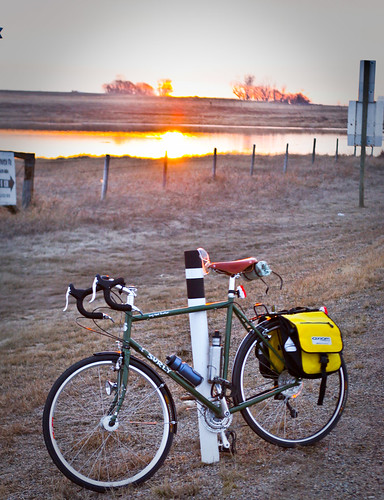 Everything I have read about this bike is positive, save for few who say it is too heavy, but let them go buy a $5000 carbon bike or something. People use it as an everyday bike such as Jerome (thanks for the great pic) and some people use it to ride across a desert in Chile (is that a machete?!?!). You can order the frameset or buy the complete bike built by Surly. Over and over again I read how people have had it for years without a hitch or ridden it from Alaska to Argentina. Overall it is just a work horse.
SO THERE.
Those are the four types of bikes I classified. Of course if you go to a manufacturers website there will be 8 different categories or so but these are the 4 big ones I can think of, and they are pretty general at that. The main thing you want to do is find a bike that feels good, and find a bike you like. If you don't you won't ride it and you will miss out on the great adventure of bicycling. But think long and hard about what you might see yourself doing as a cyclist. If you'll be mostly zipping around town, doing an occasional day trip and don't see yourself doing any really long hauls (ex: hundreds or thousands of kilometers over many days) you probably want a hybrid. If you want to go around town a little, but mainly want to go fast and get exercise in low traffic you probably want a race inspired road bike. In this case if you want a bit of a better view for traffic ask your LBS to set you up with a higher angle handle bar stem! If you want to go really fast but not in traffic, spend lots of money and get a racing bike. If you want to travel the world, go to work, get groceries, carry the kids around and more all on the one bike, maybe a touring bike is right for you. Ideally you would get a bike for every activity, but back in reality (especially to those new and not quite fanatic yet) one bike if often all one can get.
Hope this helps you pick a bike, when in doubt ask your LBS but make sure that what YOU want and what HE is trying to sell you are the same thing. To make sure go to a few places and ask them questions, peak at the websites and google some of the bikes you're thinking about. You're bound to figure it out. When in doubt get a bike that feels good to you.
Next week I'll do something a little less...intense shall we say. I'll give a run down of some bicycle lingo that might be throwing you for a loop if you're researching a bike.
Thanks for reading.
-Hughie




Great Post! Well written, researched and great info. Mucho Gracious!
ReplyDeleteThanks!
ReplyDeleteIts basically the sum of basic bike knowledge I learned while trying to pick a bike, and again when figuring out what I'm going to do for touring!
nice write up. I worked in bicycle shops for 15 years and that's as good a breakdown as I've read. BTW, I've got a surly pacer currently. cool guys, great bikes.
ReplyDeleteI should say only that its awesome! The blog is informational and always produce amazing things.
ReplyDeletebike